

If you are using learning outside the classroom (LOtC) to teach, you will quickly discover a wealth of books, websites, and resources packed with activity ideas linked to curriculum content. However, many of these present LOtC as stand-alone sessions rather than as an integrated part of teaching and learning.
In schools I have visited, LOtC often sits alongside classroom teaching rather than being meaningfully connected. When this happens, opportunities for deeper understanding, skill development, and real-life application are missed.
Reflecting on your current use of LOtC
It’s worth reflecting on how LOtC currently features in your teaching:
- Do you prepare students for trips or theatre visits so they can engage fully?
- Do LOtC experiences inspire and shape the rest of your topic planning?
- Do you develop skills so that residentials or extended visits are purposeful and successful?
- Do you link classroom learning to real-life contexts or the world of work?
- Do you use LOtC to assess understanding through real-world problem solving or applied tasks?
If your answer to some of these is “maybe” or “no,” your LOtC could be more effective. Small, deliberate changes in planning and integration can significantly boost learners’ engagement, confidence, and understanding.
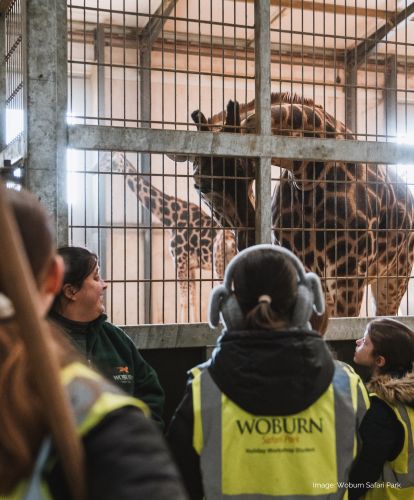
LOtC as a pedagogy, not an event
Over time, I have developed a system of fully integrated indoor–outdoor learning. This is not a collection of activities, but a teaching approach – a pedagogy.
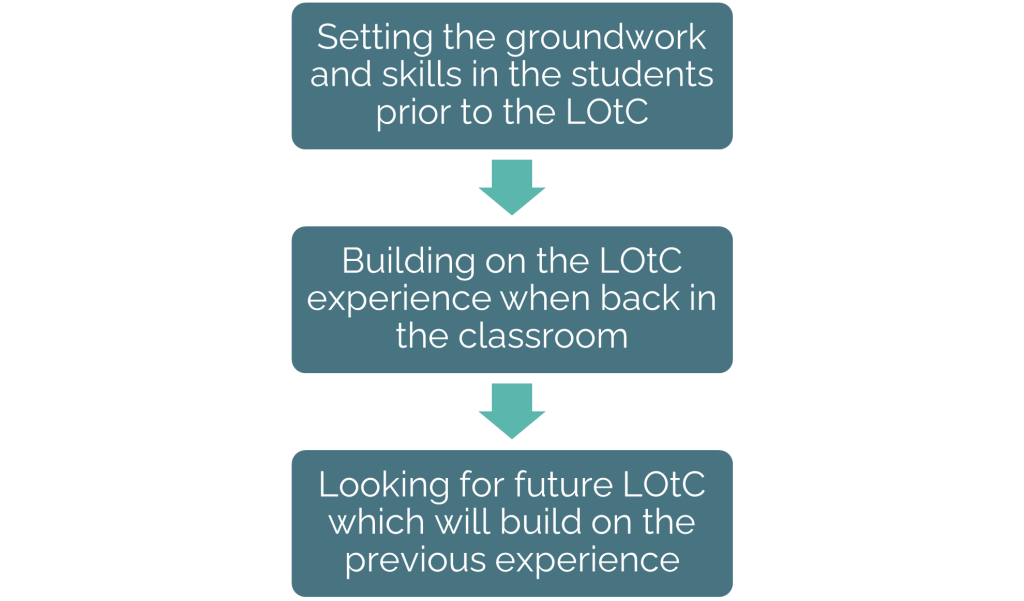
Using frameworks to integrate indoor and outdoor learning
One way to introduce integrated learning is through teaching frameworks. These structures ensure LOtC opportunities are deliberately placed within the flow of teaching. Rather than isolated events, LOtC becomes a thread running through a topic.
I have developed six indoor–outdoor learning frameworks; two are outlined below.
The Inspirational Framework

The Inspirational Framework uses LOtC to inspire further learning. It is particularly effective for place- or nature-based topics, but can be applied across the curriculum.
For example, start a topic with a walk around school grounds or a local park. Students observe, ask questions, and collect ideas. Back in the classroom, these ideas are sorted into themes—history, plants, animals, habitats, human impact. One theme is explored further through research, then students return outdoors to test, observe, and apply what they’ve learned.
Putting the inspirational framework into practice
For example, during a walk around their local learning area, a student notices a hinge on a gatepost. Back at school, research reveals that the site was once the entrance to a large country house. The students locate historical photographs of the estate and then return to the site to re-photograph the locations, comparing past and present. Further research and visits help them consolidate their findings, culminating in a locally produced historical guide. They then share their discoveries by leading a history walk for local residents and families, using their guide to bring the past to life.
Here, LOtC inspires indoor learning, and indoor learning deepens subsequent LOtC. The framework can also support storytelling, poetry, creative art, and scientific or geographical enquiry.
Your turn: Next time you plan a topic, think how LOtC could inspire learning and be threaded through the curriculum.
Making the most of field trips and visits
Off-site learning is a powerful form of LOtC, from rivers and coasts to theatres, galleries, and museums. These experiences can be transformative – but only if students are well prepared.
The Fieldwork and Visits Framework
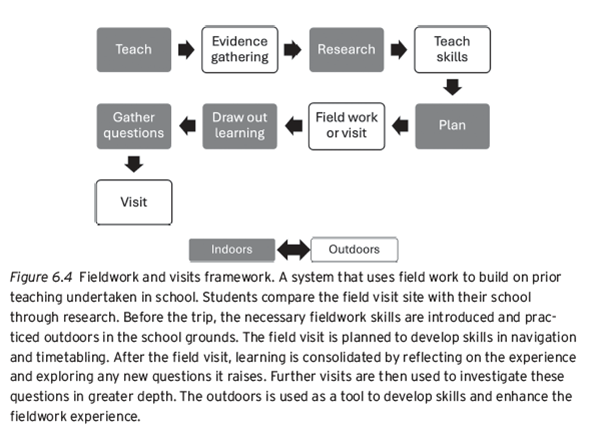
Many visits occur mid- or end-topic. Prior teaching ensures students have the subject knowledge and skills needed to make sense of what they encounter – data collection, observation, analysis, or interpreting sources. Practising these skills beforehand maximises the visit’s impact.
It’s also important to identify wider skills, such as map reading, navigation, time management, or road safety, which students can apply in a real-world context.
Working effectively with external providers is key. LOtC Quality Badge holders offer reassurance about learning quality and risk management. Even with high-quality providers, clear communication is essential:
- How should schools prepare students?
- How can sessions be adapted for individual needs?
- How do provider and school behaviour policies align?
- What follow-up activities can build on the visit?

Case study: Building effective partnerships
Claire Williams, former Head of School at Dan y Coed School, Swansea, shares her experience of working with LOtC providers to make the best use of their visits.
Dan y Coed is a specialist school and home for children with autism and learning disabilities. During a visit to St Fagans National Museum of History, many students found the unfamiliar environment overwhelming and were initially unable to engage with the experience. By communicating these barriers to the museum, we were able to work collaboratively.
Following these conversations, I worked with the museum supporting them to develop a social story that schools could watch in advance to help prepare students for their visit. I also created visual, symbol-supported resources tailored to the needs of our students which are accessible on the museum website. As a result, the museum has become far more accessible for students with additional needs, and a strong, productive partnership has developed between the school and the museum.
Reflective practice remains central to our approach. After each LOtC experience, staff consider what worked well and how learning can be extended indoors and outdoors. Moving forward we then try to integrate as many of these opportunities into their continual learning, indoors and out, capitalising on the learning experience and linking to further LOtC. Pen portraits, social stories, and clear preparation have become routine, ensuring that LOtC is purposeful and inclusive.
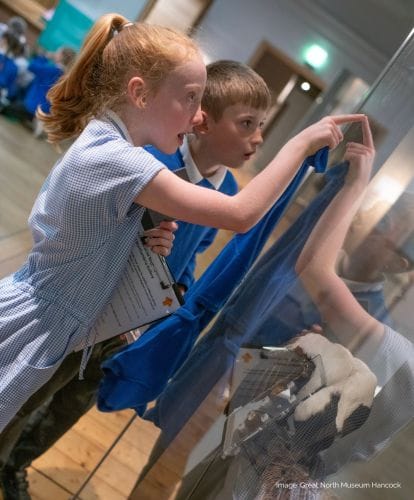
Strategic LOtC: a whole-school approach
While using frameworks for planning helps integrate LOtC into indoor learning, a whole-school approach embeds it strategically. I worked with Claire Williams for a year to foster a culture of strategic, integrated LOtC, culminating in the school achieving the LOtC Gold Mark. Below is their journey that turned the school from ‘doing LOtC’ into strategically embedded and integrated LOtC.
Journey to LOtC Gold Mark at Dan y Coed School
When I first met Dawn, we planned how to expand LOtC and maximise existing opportunities. Together, we created a policy aligned with the school’s values. I supported teaching staff implement this policy by bringing Dawn in to provide INSET training on how to make the most of the LOtC experience. Furthermore, I overhauled relevant risk assessments for venues and activities, removing barriers for the teaching staff. I provided weekly training and feedback sessions with staff, discussing what went well and how we could make the experience even better.
Dawn and I initially co-planned each topic, then distributed responsibility for key events to different classes. Staff and associates’ local links were leveraged to provide real-world learning and work experience for most pupils across the school.
Despite limited outdoor space and Individual Pupil Risk Assessments preventing loose parts or structures, we developed creative solutions: each student had an LOtC rucksack, and nearby parks and the beach became rich learning sites.
The biggest change was cultural. Staff began to see LOtC as more than outdoor or off-site trips—it could happen anywhere, including the kitchen or with visitors. Weekly reflections ensured learning remained purposeful, with leadership encouraging creativity and trust.
The result? LOtC is now fully embedded in the curriculum, giving students rich, connected learning experiences every day.
Inspired? Find out more
Fully integrated LOtC is a powerful, inclusive part of the curriculum rather than an occasional enrichment activity. When planning your next topic, ask:
- Where is the best place for this learning to happen?
- How can we build on this experience to deepen understanding?
For further support to embed LOtC into your curriculum, find out more about CLOtC’s Learning Beyond programmes: Membership, LOtC Mark, and Mentoring.

This blog post was written by:
Dawn Thomas
Dawn Thomas is the founder and CEO of Nature Days, an outdoor learning, consultancy and training provider. She has a degree in Environmental Biology, MSc in Environmental Impact Assessment and is a qualified secondary science teacher with over 25 years of teaching experience. For nearly 20 years she has worked with over 200 different schools supporting the embedding of outdoor learning into the curriculum through staff training, creation of teaching resources, talks and presentations. She has just published an outdoor learning book, Learning indoors and out in the primary school an integrated approach.
Dawn is also the chair of the Institute for Outdoor Learning (IOL) Curriculum Based Outdoor Learning (CBOL) and Field Studies Professional Practice Group and IOL Cymru South.
Claire Williams
Claire Williams brings over 20 years’ experience in education alongside extensive lived experience in inclusive practice and leadership. A qualified science teacher, Claire has spent more than 13 years working in special educational needs, predominantly supporting learners with autism spectrum disorder (ASD) and challenging behaviour.
Claire began her Learning Outside the Classroom journey in 2022 and led Dan y Coed School to achieve the Gold Mark in 2023. She has held senior leadership roles as both Deputy Head and Head of School, and in 2025 became a trustee and assessor for CLOtC. More recently, Claire has established a consultancy to support providers of learning beyond the classroom experiences to better meet the needs of SEN/ALN pupils. She is passionate about ensuring learning beyond the classroom is accessible, meaningful, and inclusive for all learners.
