

We know that nature connection is great for young people and for the environment. It has been shown to improve physical and mental health as well as promoting the development of a wide range of transferable skills.
Unfortunately, many young people today are missing out on these benefits and this is particularly true of those from disadvantaged communities. Having grown up as part of one of these communities myself, I (and many others) recognise that it’s not just financial barriers and lack of access to green spaces that are the issue. It goes much deeper than this. There are significant cultural barriers to these young people connecting with nature. Many feel that nature isn’t for them. They worry that they won’t be made to feel welcome, that they will be ridiculed for not having the latest clothing and equipment or for not knowing the names of all of the plants and animals.
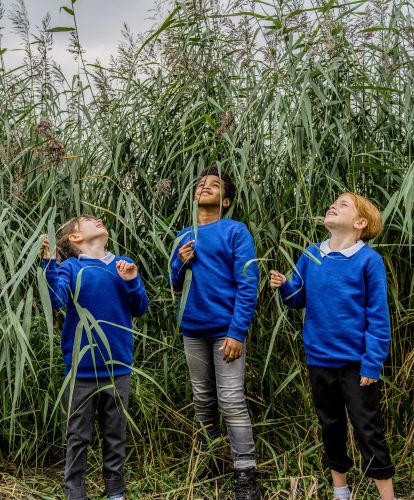
But that’s the real beauty of nature connection. You don’t need any special clothing or kit, you don’t need to go to a nature reserve or a National Park. Nature is available to everyone right on their doorstep. Something as simple as looking up at the clouds can be just as powerful as darting halfway across the country to view a rare bird through an expensive telescope. Something as simple as a flower (dare I say ‘weed’) growing through a gap in the pavement can be a source of awe and wonder. Nature connection is for everyone, it can be done anywhere and it only need take seconds.
When I think back to my childhood growing up on a council estate with little if any greenspace, it didn’t stop me connecting with nature. We didn’t have a nature reserve on our doorstep but we did have an industrial estate and a disused railway line. Here I discovered slow worms, newts, butterflies and a whole range of birds. This opened my eyes to a world of magic and wonder. I didn’t look like someone who would be into nature but that didn’t matter.
And it’s the same for today’s young people. I always tell this true story which shows exactly that. I used to run Forest School sessions for the children on the council estate where I grew up. I was out one evening laying down reptile mats (basically pieces of black roofing material that reptiles like to lie underneath to warm up), when I came across a group of youngsters having a few beers in the seating circle. When they saw me coming, they immediately went to run away. I told them there was no need to run away, I was just interested in what they were doing. They explained that they liked to come there as it was the only way they could get away from the chaos of their home lives. They asked what I was doing and when I explained said they knew a great place to find grass snakes. This was too good an opportunity to turn down. I asked if they’d like to come and show the children at Forest School and they agreed. Part of me doubted they would actually turn up or that I would ever see them again (my own prejudices coming to the fore!). But turn up they did and they were great with the younger children showing great care and gentleness in how they communicated with them. Most people would have told those youngsters to sling their hooks. It just goes to show. Don’t make assumptions. Nature really is for everyone.


Fast forward more years than I care to admit and those feelings and experiences have never left me. This has given me great passion for connecting disadvantaged groups with nature and I’m currently able to put that passion to good use at WWT where I head up the Trust’s learning programmes. Here we have developed Generation Wild, a nature connection programme aimed directly at schools, children and families in disadvantaged communities. It aims to show exactly what I’ve been saying; that nature is for everyone and can happen anywhere. Children are encouraged to complete nature activities where they live. These activities are incredibly simple, need no equipment and can be done almost anywhere. Over the last three years, 45,000 children have taken part and they’ve completed 130,000 nature activities. Not bad for children that many people might think won’t be into nature! Just like those youngsters I encountered.
So next time you see some youngsters out having a few beers on a field near you, don’t automatically chase them off. Stop and talk to them. You might be pleasantly surprised!
More on this topic...
To find out more about the Generation Wild programme and find nature activities to complete with young people see www.generationwild.org.uk.
This blog post was written by:
Mark Stead, Head of Learning at WWT, the charity for wetlands and wildlife.
Mark oversees a learning programme across their ten UK wetland sites. He has a particular passion for connecting disadvantaged young people with nature. He now enjoys exploring nature with his seven year old son, Danny, who is quickly developing his dad’s passion for all things nature.who

