

Learning Outside the Classroom (LOtC) is often framed as enrichment: the school trip, the special day, the experience that sits alongside “real” learning. At Kendall CE Primary School, our experience has been very different. Over the past decade, LOtC has gradually become the way our curriculum is lived. It has reshaped not only where learning happens, but how children experience it, talk about it, and carry it with them.
This post shares our journey — not as a model to replicate, but as a story of how learning outside the classroom can become part of a school’s culture, identity, and everyday practice.
Starting with context, not initiatives
Kendall is a single-form entry Church of England primary school in Essex, serving a diverse community with a significant proportion of pupils in receipt of the pupil premium grant. Like many schools, we were asking familiar questions: How do we make learning meaningful? How do we ensure children feel a sense of belonging? How do we create experiences that connect school to the wider world?
Our starting point was not a programme or a framework, but a shared belief that learning needed to feel real. We wanted to provide our children with learning experiences they would remember; a shift away from worksheets and clerical work towards experiential learning which formed rich connections between the pupils’ knowledge, skills and experiences. We wanted children to recognise their learning in the places they lived, played, and moved through every day. Over time, Learning Outside the Classroom became a natural response to that ambition and, over a decade ago, our visionary headteacher, Clare French, and myself set about turning one-off outdoor lessons into an everyday part of the school’s culture.

From add-on to orientation
One of the most important shifts we made was moving away from seeing LOtC as something extra. Instead, we began to think about how it could orientate our approach to teaching and learning more broadly.
At Kendall, this meant being clear about the difference between curriculum and pedagogy. Our curriculum includes the National Curriculum, Forest School provision, and a strong focus on personal development. LOtC sits within pedagogy — the how of learning rather than the what.
This distinction matters. It allowed us to stop asking, “Where can we fit outdoor learning in?” and start asking, “How does this learning want to be experienced?” We developed our curriculum over four quarters per year rather than three terms, providing a more balanced number of weeks per topic.
Building on the, then new 2014 National Curriculum, we moved away from teaching in silos to connecting topics that fit together naturally. Rather than separate books and lessons for subjects, our pupils now have one maths book and one learning journey book which contain the learning of all other subjects (including English), providing children with a seamless journey through curriculum content which enables them to make links between their knowledge and understanding. We’ve shared more detail on our curriculum structure here kendallprimary.co.uk/our-curriculum.
We soon found that LOtC became the connective tissue that helped children see learning as coherent rather than fragmented.
Small practices that quietly change culture
Some of the most powerful changes came from small, deliberate practices. One example I often return to is chalk.
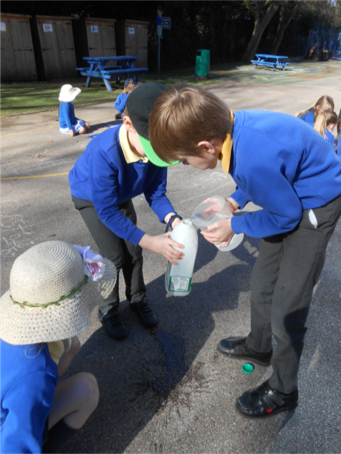
In mathematics, taking children outside with a box of chalk immediately alters the learning dynamic. Children write on the ground, often working in larger collaborative groups. The physical space allows movement and discussion. The impermanence of chalk removes the fear of mistakes — answers can be rubbed out with a foot rather than corrected in a book.
What surprised us most was how learning began to spill beyond lesson time. Chalk markings remained on the playground at break. Year 5 pupils would say, “I remember doing that in Year 4,” while Year 4 children explained their learning to younger pupils. The playground became a shared learning space — a place of memory, talk, and connection.
One of the biggest challenges in developing LOtC is shifting mindsets: moving from seeing outdoor spaces as only places for play to recognising them as places where learning belongs. Once that shift begins, the possibilities expand quickly. As one Year 6 pupil described it, “It’s like learning and playing at the same time.”

Developing staff confidence, not compliance
Embedding LOtC across a school does not happen through expectations alone. At Kendall, it required a sustained focus on developing staff confidence.
We invested in peer-led CPD, shared practice, and teacher enquiry. “LOtC Shares” allowed colleagues to observe one another informally and talk honestly about what worked — and what didn’t. Outdoor INSET days allowed staff to experience learning beyond the classroom, rather than just hear about it. We began with deliberately low-stakes challenges, such as taking one art lesson outside across a quarter, giving colleagues permission to experiment without fear of judgement. Allowing staff to experiment and try different things without fear of judgement from senior leaders, grew confidence.
Over time, this created a professional culture where experimentation was normal and risk-taking was supported. Staff engagement grew not because they were told to teach outdoors, but because they experienced the pedagogical value for themselves.
The development of our LOtC training courses and experience days extended this approach beyond our own school, creating opportunities to learn alongside other practitioners and organisations. Professional learning became relational, practical, and rooted in lived experience.
Leadership and sustainability
LOtC does not embed itself. It requires leadership that protects time, prioritises professional learning, and thinks beyond short-term initiatives. Our vision for school improvement has remained largely the same for the past decade, ensuring that LOtC remains a priority. As a school we try to avoid picking up the latest initiative for it only to be dropped a few years later and another slotted into its place. Having LOtC front and centre of all we do at Kendall for such an extended period of time has meant that it is truly embedded.
At Kendall, Learning Outside the Classroom sits within a longer-term school improvement narrative. It aligns with curriculum intent, staff development, wellbeing, and community engagement. Recognition through the LOtC Gold Mark has been valuable, not as an endpoint, but as affirmation of a culture already in place.
Sustainability shows itself in everyday ways: children who talk confidently about their learning, staff who plan creatively and collaboratively, and a curriculum that feels purposeful rather than overloaded.
Top 5 Things to Think About When Embedding LOtC
- Start with purpose, not provision Before thinking about activities or spaces, be clear about why learning outside matters for your children and community. LOtC works best when it grows from values, not timetables.
- Think pedagogy, not add-ons LOtC doesn’t have to mean extra lessons or extra planning. Ask instead: How does this learning want to be experienced? Small shifts in approach can have a big impact.
- Use everyday spaces differently You don’t need extensive grounds to begin. Playgrounds, local streets, and shared spaces can all become places for learning once mindsets begin to change.
- Build staff confidence through experience Confidence grows when staff see and feel LOtC in action. Peer-led sharing, modelling, and permission to experiment are far more powerful than directives.
- Think long-term and grow slowly Embedding LOtC is cultural work. Start small, protect time for reflection, and allow practice to develop over years rather than weeks.
Final reflections
Learning Outside the Classroom has taught us that curriculum is not just what is planned on paper, but what is lived day to day. When learning is rooted in place, experience, and relationship, it becomes something children carry with them — into the playground, into conversations, and into how they understand the world.
For schools beginning this journey, my advice is simple: start small, think relationally, and give change time to grow. LOtC is not about abandoning the classroom. It is about reimagining what learning can be, wherever it happens.
This blog post was written by:
Dr Lewis Barrett-Rodger
Dr Lewis Barrett-Rodger is Deputy Headteacher at Kendall CE Primary School in Essex, where he leads Learning Outside the Classroom and has over a decade of leadership experience. He is also an Honorary Visiting Fellow at Anglia Ruskin University and supports doctoral researchers as well as being a maths subject specialist for initial teacher education.
Lewis’ research explores children’s lived experiences of learning mathematics outdoors. His work focuses on developing creative, inclusive curricula that connect learning to place, community, and lived experience.
Connect with Lewis on LinkedIn: